
How Gutters Protect Your Roof (and Your Foundation) in Central Texas
Drainage is the cheapest roof insurance you can buy, and the most ignored.
By the Apex Roofing team · Central Texas
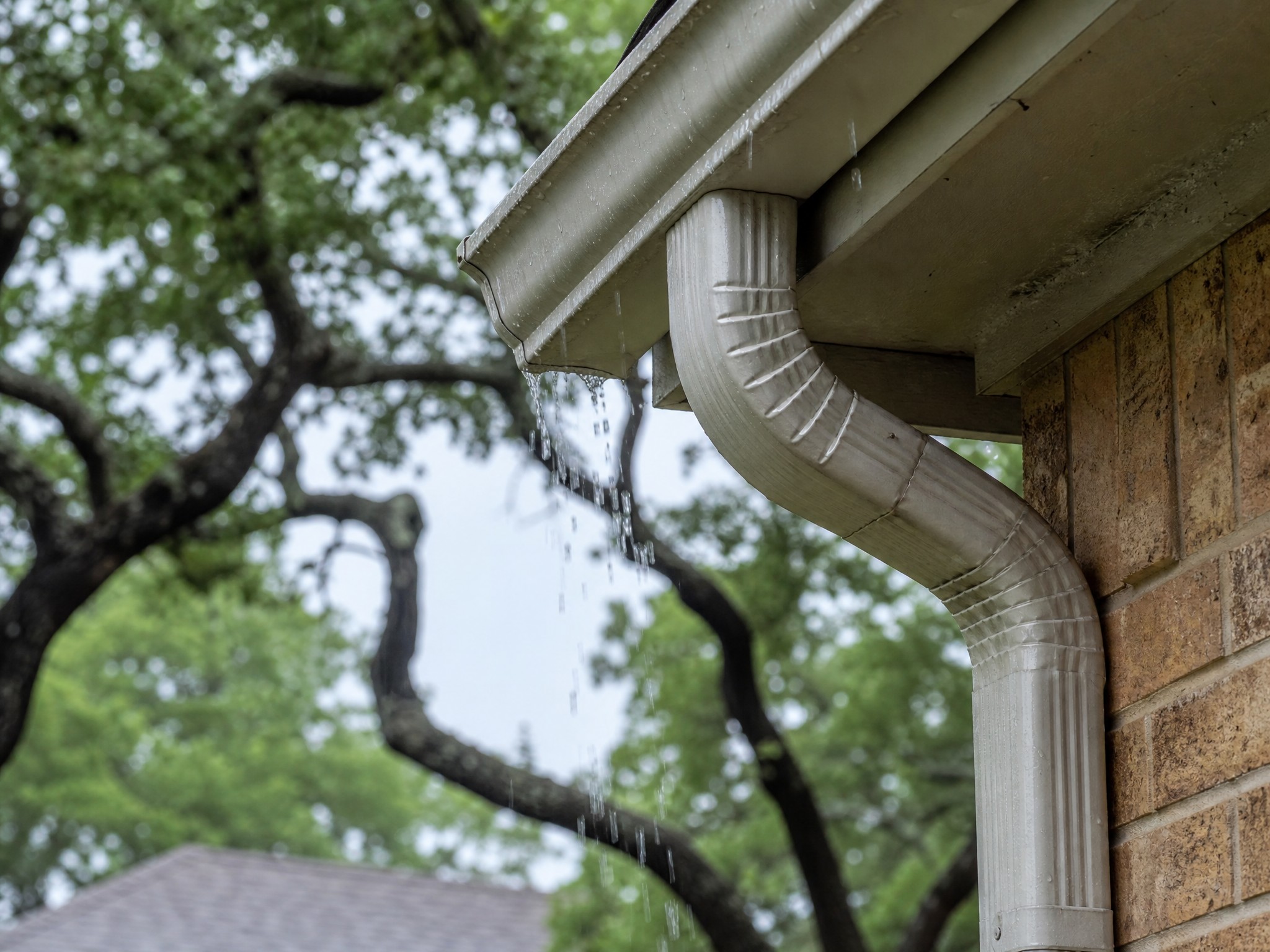
Most homeowners think of gutters as a convenience that keeps rain off your head at the front door. On a Central Texas home, gutters route storm water away from your foundation. They control where thousands of gallons of water go during our heavy spring and fall downpours, and when they fail, the damage shows up in two of the most expensive parts of the house: the roof edge and the foundation. The clay soil under Temple, Belton, and Killeen swells and shrinks dramatically with moisture, which makes proper drainage a bigger deal here than almost anywhere else.
What gutters actually do for the roof
The bottom edge of a roof is its most vulnerable point. Water collects there before it drops off, and if a clogged gutter holds that water against the shingles and fascia, several things go wrong at once. The wood fascia and decking start to rot. The bottom course of shingles lifts as the deck softens. In a rare cold snap, trapped water freezes and forces shingles apart. We have pulled apart plenty of roof edges in this area where the shingles themselves were fine but the gutter behind them had been overflowing for years.
The foundation connection
Central Texas sits on expansive clay. When that clay gets a steady soaking right next to the slab because a downspout dumps water at the corner of the house, the soil swells and pushes on the foundation. When it dries out in August, it shrinks and pulls away. That repeated cycle is what cracks slabs and racks door frames across the region. Gutters with downspouts that carry water several feet away from the house are one of the cheapest ways to keep that soil moisture stable.
Signs your gutters are failing
- Water sheeting over the front edge during a storm instead of running to the downspout.
- Granules and grit visible in the gutter trough, which means the shingles above are wearing.
- Peeling paint or rotted wood on the fascia board behind the gutter.
- Eroded soil, mulch washouts, or pooling at the base of a downspout.
- Gutters pulling away from the fascia or visibly sagging in the middle of a run.
Sizing and slope matter here
Our rainfall comes in bursts. A line of storms can drop two or three inches in an hour, which overwhelms undersized five-inch gutters on a large roof. On bigger homes we often recommend six-inch gutters with larger downspouts so the volume of a Central Texas cloudburst has somewhere to go. Slope matters too. Gutters need a slight, consistent fall toward the downspouts, and a poorly hung run will pond water and breed the rot it was supposed to prevent.
Gutter guards: useful or not?
In neighborhoods shaded by live oaks and pecans, gutter guards earn their keep by keeping leaf litter out of the trough. They are not maintenance free, though. Fine debris and oak catkins still get through and need clearing once a year. Think of guards as a way to stretch the time between cleanings, not a way to stop cleaning entirely.
Maintenance that keeps drainage working
Drainage is one of the few roof systems a homeowner can largely maintain on the ground. Clean the gutters at least twice a year, once in late fall after the oaks and pecans drop and once in spring before the heavy storms. After you clean them, run a hose into the trough and watch each downspout to confirm water flows freely and exits well away from the foundation. Add downspout extensions where water pools near the slab, since in our expansive clay even a small puddle against the house repeated over months does real damage. Check that the gutters are still pitched correctly toward the downspouts, because hangers loosen over time and a sagging run holds water instead of moving it.
Tie it into your roof care
Gutters and the roof are one system, so we inspect them together. When we do a free maintenance inspection, the gutters, the fascia, the flashing, and the roof edge all get looked at as a unit. If the roof itself needs attention, a targeted roof repair handles the shingles and the drainage in one visit. Homeowners across Killeen and the surrounding area who keep their drainage healthy protect the two most expensive systems in the house at the same time.
Related articles
Worried your drainage is failing your roof?
We inspect gutters, flashing, and the roof edge together so nothing gets missed.